Mistakes to Avoid When Buying New Construction
Buying a brand-new home can look straightforward. You tour a model home, choose a floor plan, select a lot, pick finishes, and wait for construction to finish.
In reality, purchasing new construction involves decisions that buyers may never encounter with an existing home. The advertised base price may not include the finishes you saw during your tour. Construction schedules can change. Lot premiums, design upgrades, lender incentives, HOA fees, inspections, and contract terms can all affect what you ultimately pay and when you can move in.
Understanding the biggest mistakes to avoid when buying new construction can help you make better decisions before signing a contract.
That is particularly important in Albuquerque, Rio Rancho, Los Lunas, and other growing Central New Mexico communities. New subdivisions can differ widely in builder quality, commute patterns, future development, available amenities, lot characteristics, and resale competition.
The goal isn’t to approach new construction expecting problems. It’s to know what questions to ask before your budget, timeline, or negotiating position becomes difficult to change.
A strong buying strategy starts by looking beyond the staged model and evaluating the entire purchase, including the builder, lot, financing, upgrades, contract, construction timeline, inspections, and future market position.
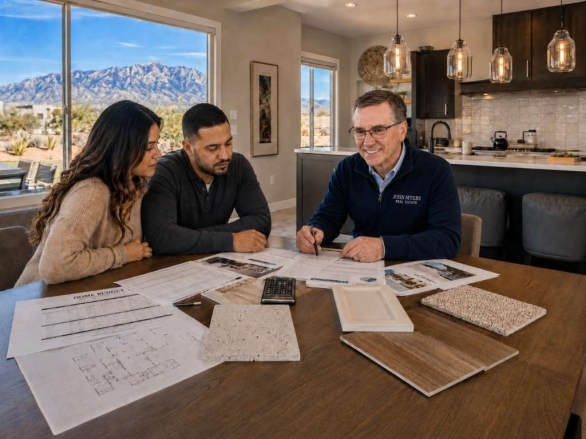
Skipping Research on the Builder, Community, and Timeline
One of the most common mistakes buyers make is assuming that because the house is new, the buying process will be easier. Your first step should be researching the builder’s reputation and the community itself.
Look at the builder’s experience in the area, warranty process, construction standards, previous communities, and how completed properties have held up. Ask your real estate agent what they have seen from the builder locally and whether there are differences between developments.
The neighborhood deserves similar attention. A newly opened subdivision may eventually have attractive landscaping, trails, parks, retail access, or other amenities, but the first few years can look very different. Buyers may experience construction traffic, equipment, dust, unfinished streets, vacant lots, and amenities that are still being built. Consider:
How long the builder expects construction to continue
Which amenities exist today and which are planned
Traffic patterns and commute times
HOA rules and fees
Nearby schools and services
Future development around the community
Whether additional builder phases could compete with your home if you sell
The timeline matters just as much. Poor planning is especially risky if you have a firm move date tied to a lease, relocation, school schedule, or sale of another home.
Weather, permitting, labor availability, utility connections, inspections, and material delays can shift a construction schedule. Your estimated completion date should therefore be treated as a planning target rather than an absolute promise unless the contract says otherwise. If your timing is extremely tight, a completed or nearly completed inventory property may be a better option than building from the ground up.
Assuming the Model Home Reflects the Real Purchase Price
The model home is designed to show what the floor plan can become, not necessarily what is included at the advertised price. That distinction can create one of the biggest budget surprises in new construction.
Models frequently include upgraded flooring, cabinets, countertops, lighting, appliances, paint, landscaping, bathroom finishes, structural options, and other features that cost extra. Even the exterior elevation or lot shown in marketing may carry an added charge.
Before comparing homes, ask for the standard-features sheet for the exact floor plan and community you’re considering. Then separate the costs into clear categories.
| Cost Area | Common Mistake | Better Approach |
|---|---|---|
| Base price | Assuming it reflects the finished model | Request a written list of standard features |
| Lot premiums | Treating the lot as a minor add-on | Add the premium to the total purchase price immediately |
| Design upgrades | Choosing selections without a spending limit | Set a design-center budget before your appointment |
| Appliances | Assuming every appliance shown is included | Confirm refrigerator, washer, dryer, and other packages |
| Landscaping | Expecting the finished model-home yard | Ask what front and backyard work is included |
| Window coverings | Forgetting them until after closing | Budget separately if they are not included |
| Electrical options | Waiting until after walls are complete | Price outlets, wiring, and prewires during construction |
| Closing expenses | Focusing only on the purchase price | Include lender fees, inspections, HOA fees, taxes, and insurance |
Pay close attention to lot premiums. A larger lot, mountain view, corner location, cul-de-sac, wider side yard, or property backing to open space may carry a sizable premium. The lot may absolutely be worth paying for, but it should be evaluated alongside your interior upgrade budget.
A buyer who stretches for both the premium lot and every design upgrade can end up with a monthly payment that feels very different from the original estimate.
Overspending at the Design Center and Misreading Builder Incentives
The design center can be one of the most enjoyable parts of buying a new construction home. It can also be one of the easiest places to overspend. Cabinet finishes, flooring, countertops, tile, lighting, hardware, paint packages, electrical additions, and structural changes can accumulate quickly.
Before your appointment, decide where your money should go. Give priority to items that would be expensive or disruptive to change after closing. Depending on the home, that may include cabinet configurations, additional electrical outlets, wiring, certain tile installations, plumbing-related changes, or structural options Cosmetic improvements may be easier to complete later.
A practical pre-appointment list might include:
- Must do during construction: structural changes, wiring, cabinet layout, plumbing-related selections, built-in features.
- Worth considering through the builder: flooring, countertops, tile, lighting, appliances.
- Can wait until after closing: paint, many light fixtures, hardware, window treatments, and some landscaping projects.
Set a spending cap before you see the samples. That limit gives you a framework when several appealing choices compete for the same dollars.
Builder incentives require the same discipline. A builder may offer closing-cost credits, interest rate buydowns, appliance packages, upgrade allowances, lot-premium reductions, or other incentives.
The mistake is assuming the largest advertised incentive is automatically the best deal. Some incentives require using a preferred lender. That can be valuable, but compare the full financing picture rather than focusing only on the credit.
Review the interest rate, points, lender fees, monthly payment, cash required at closing, and whether a rate buydown is permanent or temporary. Outside financing may occasionally produce better long-term numbers even when the upfront incentive is smaller.
Signing Builder Contracts without Understanding the Terms
New-construction contracts deserve careful attention. Builder contracts are generally prepared for the builder’s transaction process and may differ substantially from the agreements used for resale homes.
Don’t assume something mentioned during a sales conversation is part of your agreement unless it appears in writing where appropriate.
Review:
Earnest money and deposit requirements
Whether deposits are refundable
Financing deadlines and contingencies
Estimated construction and closing dates
How delays are handled
Material substitution provisions
Upgrade and change-order policies
Inspection rights
Builder warranty terms
HOA documents and fees
Walkthrough procedures
What happens if financing changes
Any escalation or price-adjustment language
This is also where independent representation matters. The sales representative in a builder’s office can provide useful information about the community, lots, floor plans, and available incentives. Their role, however, is connected to the builder.
A buyer’s agent provides a different perspective. Ideally, involve your agent early rather than waiting until after you have selected a property and signed documents. Builder registration policies can vary, so contacting your realtor before your first model-home visit is often the cleaner approach.
One of the Most Common Mistakes: Skipping Inspections and Ignoring Future Resale
New doesn’t mean flawless. Another mistake is assuming that because the property has never been occupied, an independent home inspection has little value.
Construction involves many trades, materials, installations, and inspections. Issues can still occur even with a reputable builder. Depending on the construction stage, contract, and inspector you hire, inspections may identify issues involving roofing, electrical systems, plumbing, HVAC, grading, drainage, insulation, finishes, appliances, doors, windows, or other components before you take possession.
Ask what inspection access the builder allows and what procedures apply when concerns are found. Don’t wait until the closing walkthrough to start thinking about workmanship. Your final walkthrough should also be approached carefully. Document incomplete or damaged items, confirm how remaining work will be handled, and understand the warranty process before moving in.
Resale deserves attention as well, even if you expect to own the home for years. A new property doesn’t automatically maintain a permanent premium simply because it was originally purchased from a builder. If a builder is still selling brand-new versions of your floor plan when you decide to move, your property may compete with those homes and whatever incentives the builder is offering at that time.
New construction incentives can influence nearby resale values because buyers may compare existing properties with builder rate buydowns, closing-cost assistance, and upgrade packages. That doesn’t mean you should avoid personalized upgrades. Choose features you will enjoy. Just think carefully before spending heavily on highly specialized improvements with limited appeal to other buyers.
Lot location, usable floor plans, practical storage, durable finishes, privacy, and access to neighborhood amenities can often matter as much as decorative upgrades when a property returns to the real estate market.
Make Your New Construction Purchase with the Full Picture in Mind
The strongest way to avoid costly mistakes is to evaluate the entire transaction before becoming attached to one floor plan, lot, or promotion.
Research the builder and community. Understand the construction schedule. Get the exact list of standard features. Add upgrades and unexpected costs to your budget before calculating affordability. Compare incentives and lenders using the complete financial picture. Read the contract carefully, arrange appropriate inspections, and think about how the property may compete when you eventually sell.
If you’re considering a construction home in Albuquerque, Rio Rancho, Los Lunas, or another Central New Mexico community, contact Myers & Myers Real Estate before or early in your builder search. Their team can help you compare builders, communities, available inventory, incentives, contracts, and long-term value so you can approach the buying process with clearer information and fewer costly surprises.
